Weeks before the bomb worked
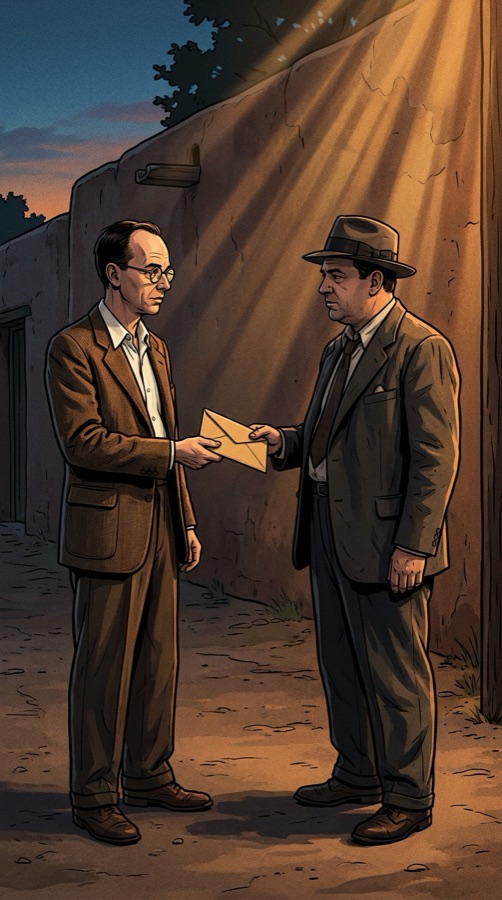
In June 1945, Klaus Fuchs handed Harry Gold a description of a weapon that did not yet exist. Fuchs met Gold in Santa Fe on 2 June 1945 and again on 19 June. On the first meeting he passed over a detailed account of the Fat Man device — dimensions, the explosive-lens configuration, the initiator design, the expected yield. The Trinity test was still six weeks away. The Americans themselves would not know their plutonium implosion design actually worked until 05:29 on 16 July, when the desert lit up.
Here is the detail that decided the second nuclear race: the Soviets received a tested design before the design had been tested. When Trinity succeeded, it did not just prove the bomb to Los Alamos. It confirmed, in Moscow, that the blueprints already sitting in a file were good. A single-source intelligence operation can be fed a lie. This one could not be, because Moscow had a way to check.
The spy who checked the spy
Fuchs is the famous name. There was a second spy. In October 1944, a nineteen-year-old walked into the Amtorg trade office on 24th Street in Manhattan and volunteered. His name was Theodore Hall. He had a Harvard physics degree taken at eighteen, and he was the youngest physicist at Los Alamos. He was working on the same weapon Fuchs was — the implosion mechanism of the Fat Man design — and he handed a Soviet contact a report he had written himself.
Fuchs and Hall did not know about each other. They passed Fat Man's details to separate handlers, through separate channels, at roughly the same time. This is the mechanism that made the espionage decisive. Moscow Center did not have to trust either man; it laid the two streams side by side and read them against each other. Two independent sources describing the same weapon are almost impossible to dismiss as deception. The cross-validation is why the intelligence was actionable rather than merely interesting — and it is the quiet, structural reason the monopoly was doomed years before it broke.
Hall's later life is its own strange coda. A Venona decrypt identified him; the FBI interrogated him in March 1951; he refused to confess, and the Bureau declined to prosecute — because a trial would have revealed that the United States was reading Soviet cables. He emigrated to Cambridge in 1962, worked at the Cavendish Laboratory, and publicly admitted the espionage only in 1997. He was never charged.
The order that came before the target
Soviet intelligence is usually said to have started collecting nuclear research in 1942. The deeper fact is that the machine was pointed at the target before the target had a name. In September 1940 — before the Manhattan Engineer District existed, before Los Alamos, before Fermi's Chicago pile — Leonid Kvasnikov, the NKVD's chief of scientific-technical intelligence, signed a circular ordering Soviet residencies in the United States, Britain, and Scandinavia to collect everything on uranium-bomb research.
The codename was Enormoz — a Russian transliteration of the English word "enormous." By the time Los Alamos was running in 1943, Moscow already held a target list of the Western physicists worth watching. Kvasnikov himself was posted to New York in 1943 as deputy rezident, and from there he ran the entire American atomic network: Fuchs, Hall, the courier Harry Gold, and the Rosenberg ring. The Soviet program did not so much recruit these men as receive them. Fuchs, a German communist who had joined the KPD before Hitler and fled a Storm Trooper beating in 1933, took no payment — only small expense reimbursements. In his 1950 confession he explained a belief, not a bribe: that the Soviets were allies and should know what the West knew. Hall came of politics during a war in which the Soviet Union was on the American side. Neither was bought. The network's advantage was that it did not have to buy them.
Bolt for bolt
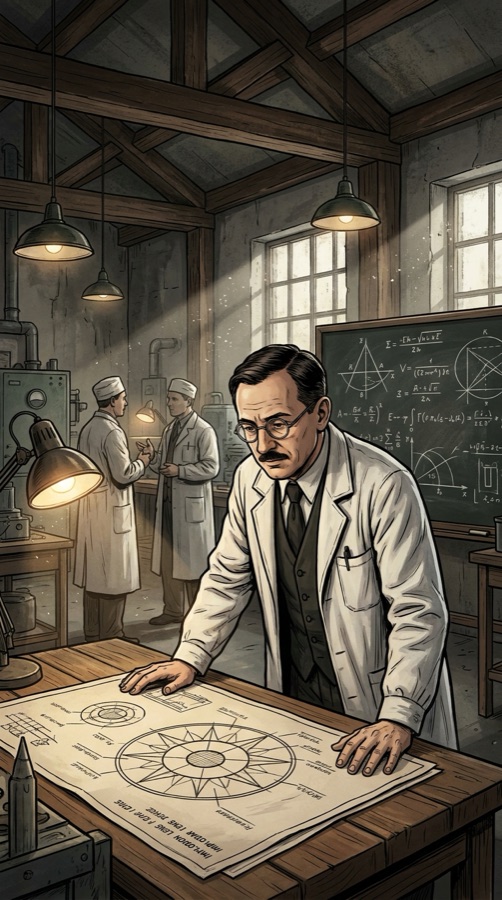
"Bolt for bolt" is not a figure of speech. Yuli Khariton, chief designer at the Soviet weapons laboratory at Arzamas-16, built RDS-1 as a deliberate near-exact copy of Fat Man. He wanted to confirm the design he had been handed was reliable before trusting Soviet variations, so the first Soviet bomb reproduced the American one down to details Khariton would later, in post-Soviet interviews, openly acknowledge came from the blueprints. There were minor Soviet refinements — the uranium-238 tamper dimensions, some high-explosive lens detail — but the core was Fat Man.
The plutonium for that copy came from Chelyabinsk-40, a closed city in the Urals built in eighteen months from 1946, largely with slave labour. At 07:00 local on 29 August 1949, on a thirty-metre tower at the Semipalatinsk test site in Kazakhstan, RDS-1 released twenty-two kilotons. American intelligence had estimated 1953 at the earliest for a Soviet bomb; the British had said 1954. By Khariton's own later reckoning, the espionage saved the program one to two years; without it, the first Soviet bomb would have slipped to 1951 or 1952.
The announcement that hid what it revealed
The discovery is usually told as a single beat: a surveillance plane finds the dust, and Truman goes public before Moscow can. Both halves are true, and the timing is tighter than the compression suggests. A WB-29 weather-reconnaissance aircraft flying the "Loon Charlie" route between Japan and Alaska picked up radioactive debris on 3 September 1949 — five days after the shot. The three weeks that followed were analysis and confirmation, not searching.
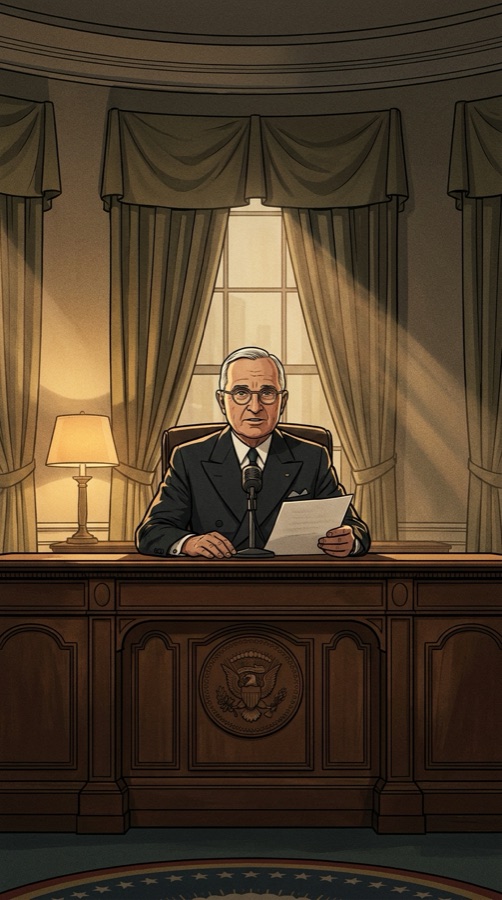
Truman announced it on 23 September 1949, two days before TASS confirmed it on the 25th. He said only: "We have evidence that within recent weeks an atomic explosion occurred in the U.S.S.R." Not "the Soviets tested a bomb" — "an atomic explosion occurred," a phrasing that left open the possibility of a reactor accident and bought a few days of managed public reaction. The president confirmed the end of the monopoly in language chosen to blunt what it confirmed.
The evidence that surfaced decades later
All of this is settled fact today — but it is worth knowing how recently it became sayable. Fuchs was identified in 1949 by the Venona decrypts: a US counterintelligence program that broke into Soviet one-time-pad cables and partially or fully read some 2,990 messages. Venona was not declassified until 1995–96. It named Fuchs as "Charles" and Hall as "MLAD" — the reason Hall could never be tried without exposing the source.
The fuller archival picture is stranger still. Vasili Mitrokhin, a KGB archivist, spent 1972 to 1984 hand-copying First Chief Directorate files, buried the notes under his dacha, and in 1992 defected to Britain carrying six trunks of them. The most complete record of Soviet atomic-intelligence operations now sits, of all places, in the Churchill Archives Centre in Cambridge. Fuchs, for his part, confessed to MI5's Jim Skardon on 24 January 1950 and was convicted that March. His sentence was fourteen years — the British maximum, because at the time of the passing the Soviet Union had been an ally, and the law drew a distinction between spying for a friend and spying for an enemy. He was released in 1959 and left for East Germany. The monopoly had lasted four years. The arms race it opened would run four decades, and eventually stack up more than seventy thousand warheads — almost all of them American and Soviet.
Next, the race stops being a superpower story: two American allies, humiliated at Suez, decide they can no longer rely on Washington's umbrella. That is Part 3: The Patron Break.
Sources
- Fuchs's June 1945 handoff and his motive: Atomic Heritage — Klaus Fuchs; Klaus Fuchs
- Theodore Hall, the Amtorg walk-in and why he was never prosecuted: Atomic Heritage — Theodore Hall; Theodore Hall
- Kvasnikov, the 1940 collection order and Operation Enormoz: Leonid Kvasnikov; Soviet atomic bomb project
- Khariton, RDS-1 and the copied design: RDS-1; Holloway, Stalin and the Bomb (Yale University Press, 1994)
- The WB-29 detection and Truman's statement: RDS-1; Truman Library — Statement announcing the atomic explosion in the U.S.S.R., 23 September 1949
- Venona and the Mitrokhin Archive: Venona project; NSA — Venona documents; Churchill Archives Centre, Cambridge; Mitrokhin Archive
- The arms-race scale and warhead peak: FAS Nuclear Notebook; Rhodes, Dark Sun: The Making of the Hydrogen Bomb (1995)
The illustrations above are reconstructions of documented events. All quotes, dates, and figures are drawn from the sources listed.