Nazi Germany discovered nuclear fission first, in December 1938, and still lost the race to build the atomic bomb. The reason is the cruelest kind of self-inflicted wound: the regime had spent the previous five years expelling the physicists who could have built it, and handed that talent — free of charge — to the United States. What follows is how a country that started the atomic age managed to hand it away.
Who discovered nuclear fission — and why it didn't help Germany
The Germans discovered fission but couldn't explain it. On 22 December 1938, in a laboratory in Berlin-Dahlem, the chemist Otto Hahn submitted a paper describing something he could not bring himself to name. Bombarding uranium with slow neutrons, he and Fritz Strassmann kept finding barium — an element far lighter than uranium. The measurement said the uranium nucleus had split, and everything physics knew said that was impossible. Hahn wrote like a man apologizing for his own data: "As nuclear chemists fairly close to physics we cannot yet bring ourselves to take this step which contradicts all previous experience in physics."
The person who could take the step was no longer allowed to live in Germany. Lise Meitner, Hahn's longtime collaborator — Jewish, her Austrian passport voided by the Anschluss — had fled to Sweden that July, smuggled out through the Netherlands with Hahn's help. He secretly mailed her the data.
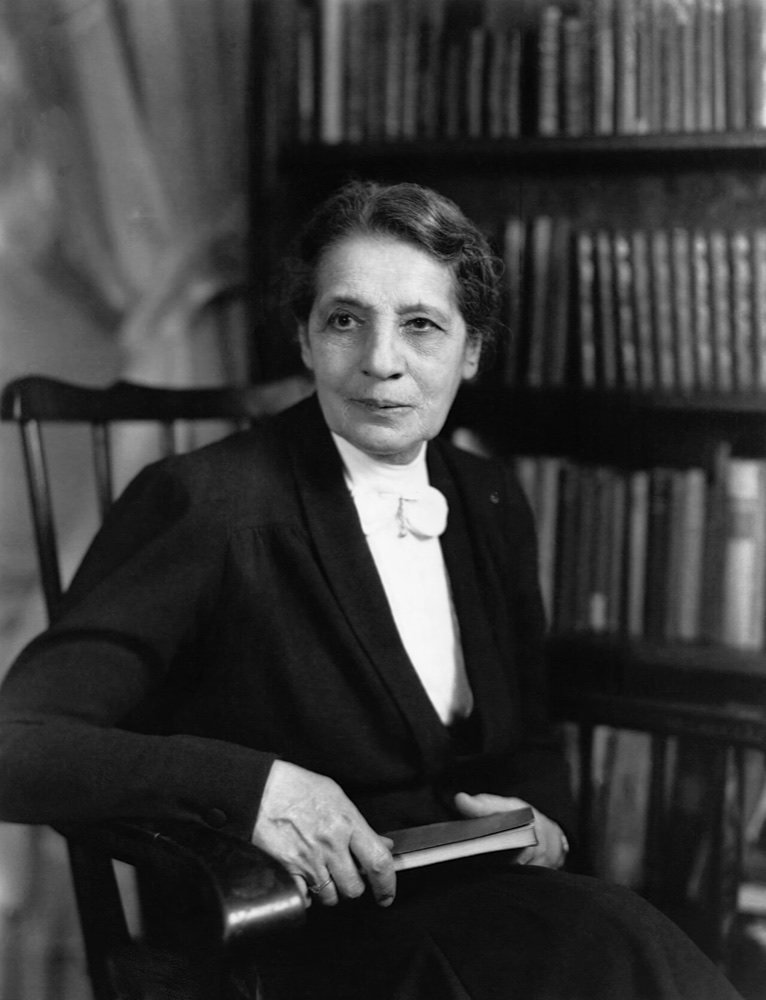
Over Christmas, walking in the snow near Kungälv with her nephew Otto Frisch, Meitner did the physics Hahn couldn't. Working from Bohr's liquid-drop model, they calculated that each splitting nucleus would release about 200 million electron volts. Frisch borrowed a word from cell biology for what the uranium was doing: fission. The discovery was German. The understanding belonged to two people Germany had already thrown away.
Who built the atomic bomb?
The atomic bomb was built, overwhelmingly, by the scientists Nazi Germany forced out of Europe. The April 1933 Law for the Restoration of the Professional Civil Service, followed by the Nuremberg Laws, purged roughly a quarter of Germany's physics faculty; around 2,600 scientists and scholars left in the first year alone. What the Reich called the cleansing of "Jewish physics" was, in practice, a transfer of the twentieth century's decisive intellectual capital — delivered to its enemies.
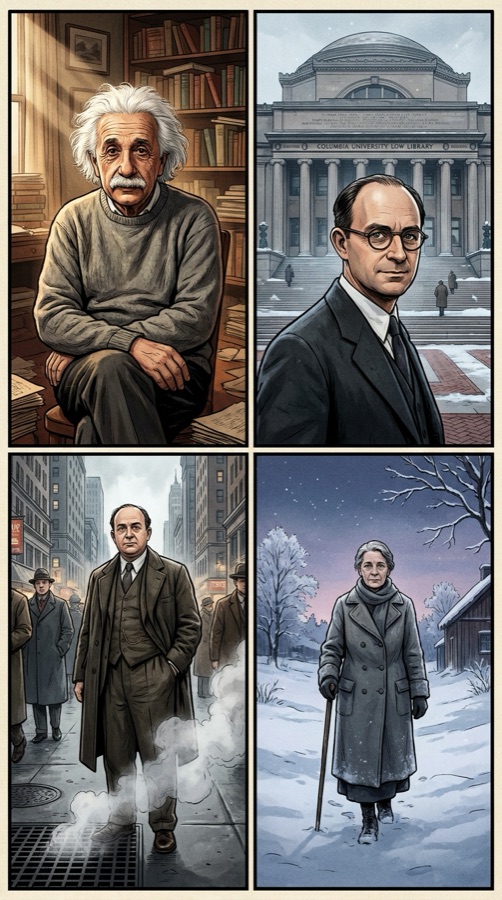
Read the Manhattan Project's org chart against the exodus and the pattern stops looking like coincidence. Leo Szilárd, who conceived the chain reaction, fled Berlin right after the Reichstag fire. Enrico Fermi took his Jewish wife and family straight from the 1938 Nobel ceremony in Stockholm to New York, nearly four years before his pile under the Chicago stands proved the chain reaction worked. Hans Bethe, dismissed from Tübingen as "non-Aryan," ran the Theoretical Division at Los Alamos. Emilio Segrè, expelled by Italy's racial laws, made the measurement that forced the bomb's redesign; John von Neumann solved the implosion-lens mathematics that made the redesign work. Niels Bohr was smuggled out of Denmark days ahead of a Gestapo arrest order and turned up at Los Alamos under the name "Baker." And a young German communist named Klaus Fuchs, beaten by the SA in 1933, found refuge in Britain and, eventually, a desk in Bethe's division.
How a $6,000 committee became the Manhattan Project
The Manhattan Project began as a warning letter from refugees and a budget that would not have bought a house. In July 1939, Szilárd was worried enough to travel out to Long Island to see Einstein. Told that a chain reaction in uranium was now plausible, Einstein reportedly said: "I had not thought of that at all." Szilárd drafted a warning to the president; Einstein signed it on 2 August 1939. Then Germany invaded Poland, and the most consequential letter of the century sat undelivered for two months.
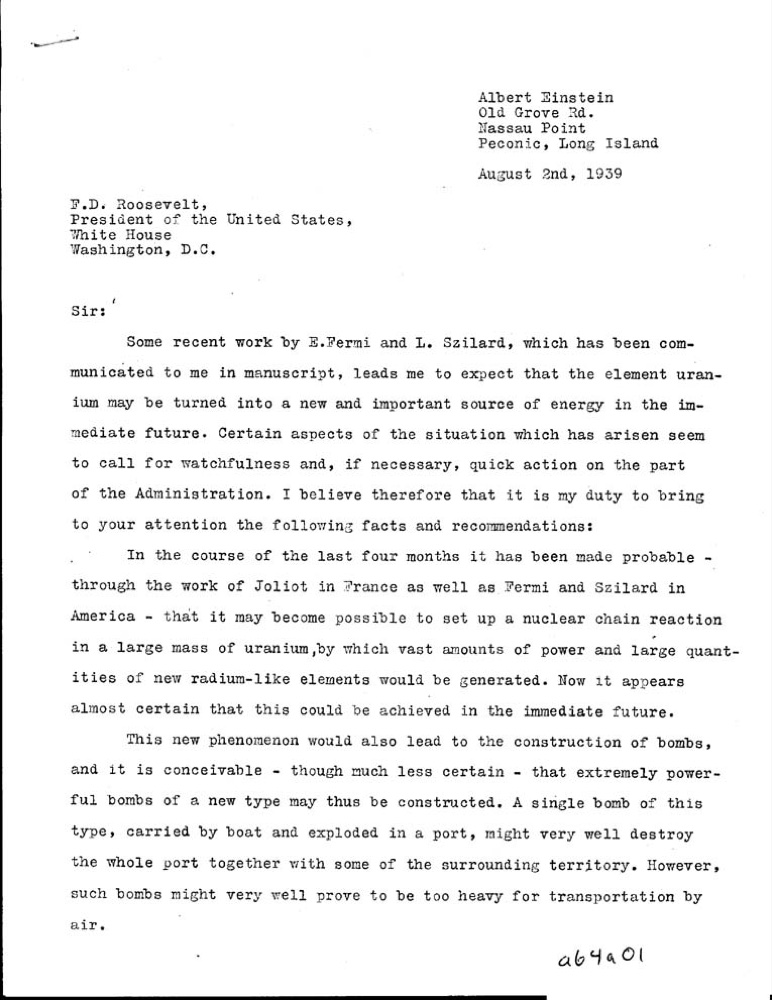
It reached Franklin Roosevelt on 11 October, read aloud over breakfast by the economist Alexander Sachs. Roosevelt's reply had the compression of a man who understood the memo faster than its authors: "Alex, what you are after is to see that the Nazis don't blow us up." Eight days later he created the Advisory Committee on Uranium — with an initial budget of six thousand dollars.
That committee became the Manhattan Engineer District: 130,000 workers at peak and about $1.9 billion through 1945 — roughly $30 billion in today's money. At Oak Ridge, the K-25 gaseous-diffusion plant was, at its completion, the largest building in the world under one roof. The founding document of the atomic age was a letter from refugees warning America about the country that had expelled them.
What was Heisenberg's mistake that cost Germany the bomb?
Germany lost the bomb to a single arithmetic error. In March 1940, two more refugees — Otto Frisch and Rudolf Peierls, working in Birmingham — calculated how much uranium-235 a bomb actually needed. Their answer was about 600 grams. Werner Heisenberg, running the German program's key calculations, had put it at tons.
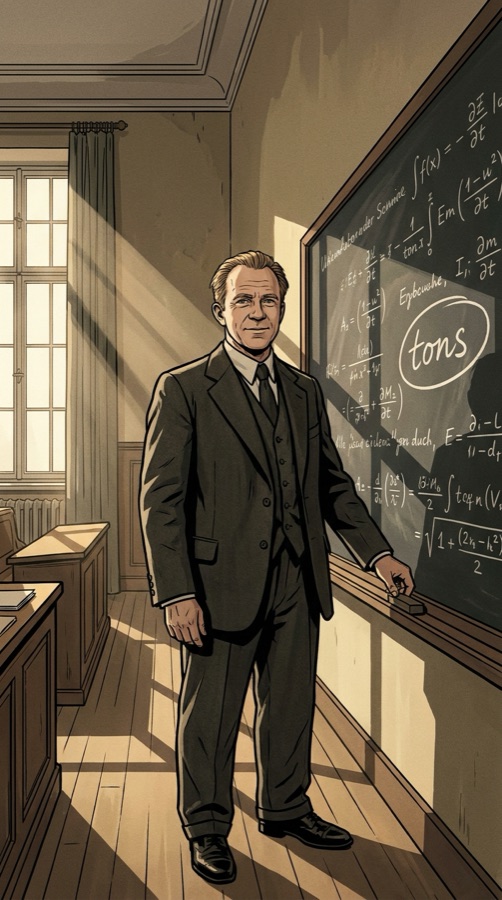
That single error decided nearly everything. A weapon needing a few hundred grams of U-235 is an industrial project a nation at war might attempt; a weapon needing tons is a fantasy for the next generation. In June 1942, briefed on his physicists' own pessimistic numbers, armaments minister Albert Speer deprioritized the project. The Frisch–Peierls memo, meanwhile, became the seed of the MAUD Report and the British case that pushed the Americans to build in earnest. The race was effectively decided by a calculation — done correctly only by the exiles.
How did commandos sabotage the German bomb in Norway?
Germany's program had a second, physical vulnerability, and Norwegian commandos exploited it. A measurement error had convinced the Germans that graphite wouldn't work as a reactor moderator, so their design depended on heavy water — and occupied Europe had exactly one industrial source: the Norsk Hydro plant at Vemork, Norway.
The first Allied attempt, Operation Freshman in November 1942, was a catastrophe: a glider-borne raid that crashed in bad weather, its survivors executed under Hitler's Commando Order. Three months later, nine Norwegian commandos under Joachim Rønneberg skied across the Hardangervidda plateau in midwinter, climbed down and up a 200-meter ravine the Germans had judged impassable, and blew up the electrolysis cells — half a ton of heavy water lost, without a shot fired. A year later, when the Germans tried to move their remaining fourteen thousand litres to the Reich, the resistance sank the ferry carrying it to the bottom of Lake Tinnsjø, drowning fourteen Norwegian civilians and four Germans with it. The sabotage ended the German bomb's last realistic path.
What did the Farm Hall transcripts reveal about the Nazi bomb?
The Farm Hall transcripts revealed that the German scientists never came close. In the summer of 1945 the Allies interned ten captured German nuclear scientists — Heisenberg and Hahn among them — in a bugged country house at Godmanchester called Farm Hall. For six months, hidden microphones cut their conversations onto shellac discs, and the transcripts stayed classified for forty-seven years.
On the evening of 6 August 1945, the commandant quietly told Hahn about Hiroshima before the BBC bulletin. Hahn — the man whose 1938 experiment had started it all — was so distressed he threatened suicide, and told Heisenberg: "I thank God on my bended knees that we did not make a uranium bomb." The group's first reaction to the broadcast was disbelief: they had concluded a bomb was out of reach, because they were still using Heisenberg's numbers.
Then the transcripts record something remarkable. Over the following week Heisenberg worked out a correct bomb mechanism from first principles and, on 14 August, lectured the others on it — brilliant, fast, and years too late. It was work he had plainly never done during the war. That same day, Hahn turned on him: "Tell me, Heisenberg, you have often said to us that one needed about 50 kg of Uranium 235 for a bomb, now you say you need two tons?" Historians still argue whether Heisenberg had genuinely confused himself during the war, or had been performing incompetence for an audience he suspected was listening.
Was the Trinity test the first atomic bomb?
The Trinity test was the first nuclear detonation, but not the first atomic bomb to be used. At 5:29 on the morning of 16 July 1945, in the New Mexico desert, Trinity released the energy of about twenty thousand tons of TNT.
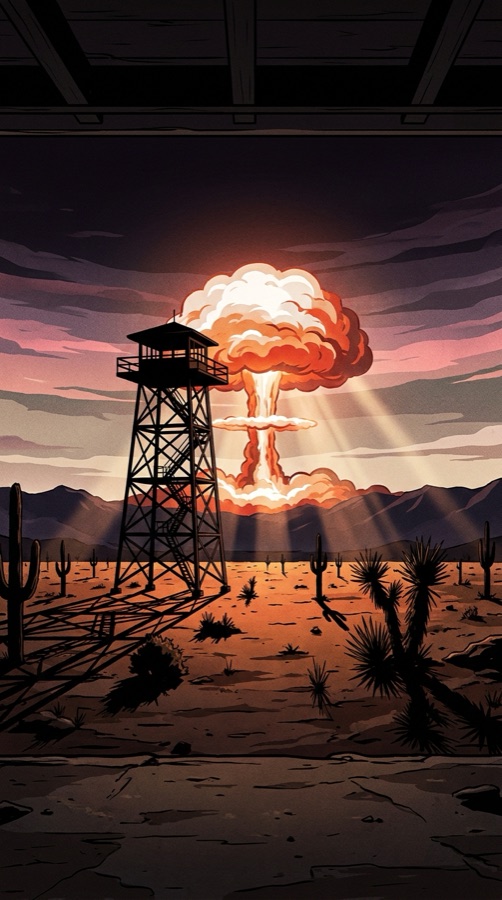
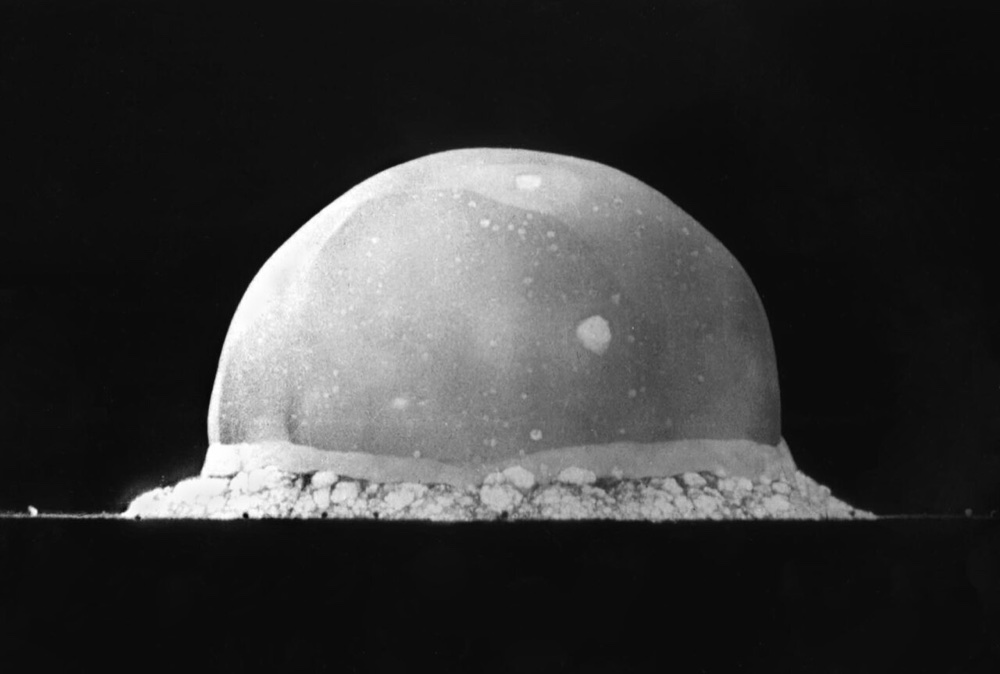
What Trinity proved was the plutonium implosion design — the harder of the two bombs. The uranium bomb dropped on Hiroshima three weeks later had never been tested at all; enriched uranium was too scarce to spend on a rehearsal.
Did the Soviets steal the atomic bomb?
Yes — and the theft was already complete before the American bomb had even been proven. In June 1945, weeks before Trinity, a theorist from Bethe's division met a courier named Harry Gold in Santa Fe and handed over a detailed description of the implosion device: dimensions, explosive-lens configuration, initiator, expected yield.
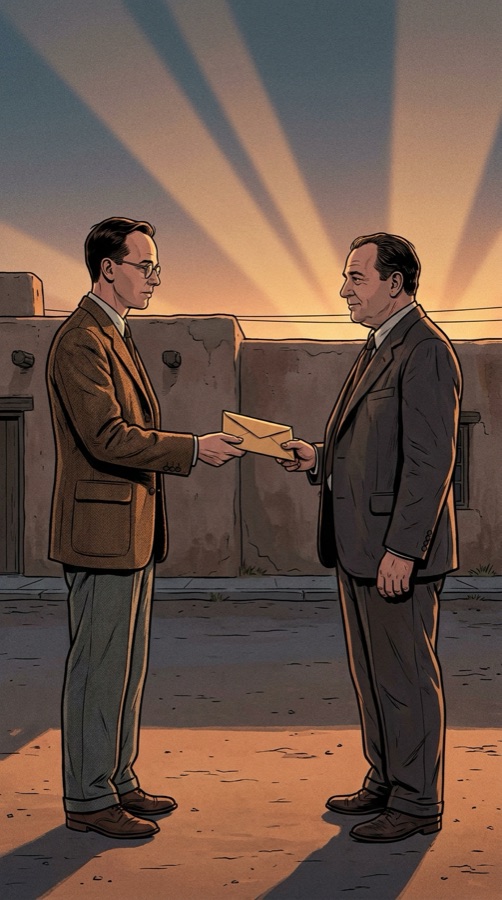
It was Klaus Fuchs — the refugee from the list, the man the SA had beaten in 1933 and Britain had sheltered. Germany had started the race and lost it. But a second race was already underway, and its starting gun was an envelope.
Sources
- Hahn & Strassmann's December 1938 paper and Hahn's hesitation: APS News — December 1938: Discovery of Nuclear Fission; Science History Institute — Hahn, Meitner and Strassmann
- Meitner, Frisch and the naming of fission: Discovery of Nuclear Fission
- The refugee scientists of the Manhattan Project: National Museum of Nuclear Science — Scientist Refugees and the Manhattan Project
- The Einstein–Szilárd letter and the $6,000 committee: Nuclear Museum — Einstein–Szilard Letter; Einstein–Szilard letter
- Manhattan Project scale and cost: Manhattan Project; Restricted Data — The price of the Manhattan Project
- The critical-mass question and Farm Hall: Jeremy Bernstein, "The Farm Hall Transcripts," NYRB, 13 August 1992; AIP — Heisenberg and Farm Hall; Operation Epsilon
- The Norwegian sabotage chain: Nuclear Museum — Operation Gunnerside; IWM — Operation Freshman; Norwegian heavy water sabotage
- Trinity, Little Boy and the untested uranium design: Trinity (nuclear test); Little Boy
- Fuchs's June 1945 handoff: Klaus Fuchs; Atomic Heritage — Klaus Fuchs
The copied bomb, the spies who mailed it east, and the four-year monopoly that wasn't — that story is Part 2: The Monopoly Breaks.